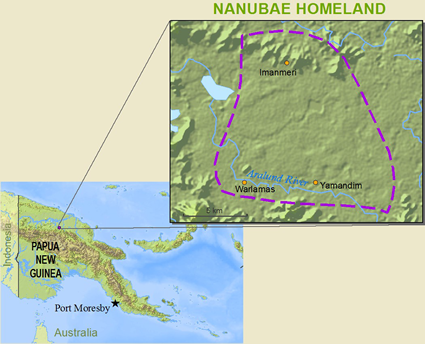

The Nanubae people live in several small villages in the East Sepik Province of Papua New Guinea, particularly along the Arafundi River, including the communities of Imanmeri, Yamandim, and Wambrumas. Their language belongs to the Arafundi family and is spoken in two closely related dialects divided among these villages. The Nanubae have lived for generations in this remote river environment, and outside influences began to increase during the mid-twentieth century when Catholic missionaries first established work in the area, followed later by other church groups that formed small congregations.
The Nanubae people maintain a subsistence lifestyle shaped by their riverine and forest surroundings, with sago serving as their primary staple food, processed from the trunk of the sago palm, and supplemented by fish caught in nearby waterways. Their daily routines likely resemble those of neighboring Arafundi River communities, where fishing, small garden plots, and the gathering of forest resources provide the essentials of life. Canoes are the main form of transportation, linking villages and enabling movement along the river for trade, communication, and social interaction.
Community life is centered in small, close-knit settlements where cooperation is necessary for food production and daily survival, and where knowledge is passed down through family and communal relationships. Access to formal education exists in some villages, with elementary schools using both the local language and Tok Pisin, though life remains largely rooted in traditional patterns.
The Nanubae people primarily follow traditional ethnic religious beliefs that recognize spiritual forces at work in the natural world, including a strong awareness of spirits and their influence over daily life. Although many Nanubae would identify themselves as Christians due to the presence of church activity, this identification is often mixed with longstanding traditional practices, including the use of ritual or magic in areas such as hunting, fishing, and relationships. Fear of evil spirits and the need to manage or appease them continue to shape spiritual thinking, resulting in a blended belief system where Christian ideas and traditional practices exist side by side.
The Nanubae people would benefit from clear and culturally meaningful teaching that communicates truth in their own language and worldview, especially in ways that address the ongoing influence of fear and traditional spiritual practices. Continued progress in Bible translation and oral communication methods would help make scripture more accessible to those who are not comfortable in trade languages. There is also a need for workers who are willing to live among the Nanubae, build relationships, and provide consistent discipleship that moves beyond nominal identification toward deeper understanding and faith. Strengthening education, literacy, and community development efforts would also support both physical well-being and spiritual growth.
Pray that Scripture and teaching resources will become available in forms that are easily understood, especially for those who rely on oral communication.
Pray that those who identify as Christians will grow in genuine faith in Jesus and put all their faith in him.
Pray for Nanubae disciples who will make more disciples.
Pray for unity, provision, and encouragement within the villages as outside influences continue to increase.
Scripture Prayers for the Nanubae in Papua New Guinea.
Anonymous
| Profile Source: Joshua Project |